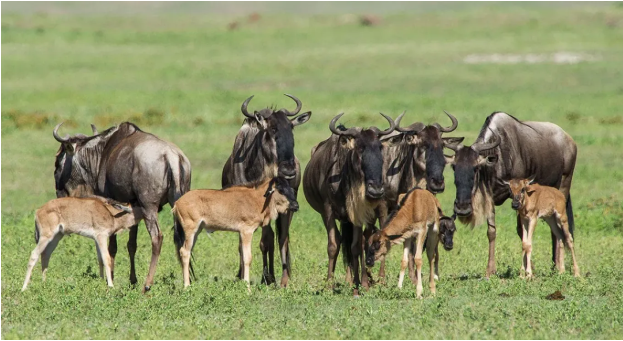
The Ndutu region of Tanzania’s Serengeti ecosystem hosts one of nature’s most extraordinary events each year, the wildebeest calving season. Between late January and March, approximately 500,000 wildebeest calves are born on the short-grass plains, transforming this vast landscape into the world’s largest maternity ward. This concentrated birthing phenomenon attracts not only wildlife enthusiasts and photographers but also predators in extraordinary numbers, creating dramatic life-and-death interactions that define the raw power of African wilderness. A Ndutu calving season safari offers unparalleled wildlife viewing opportunities where the circle of life unfolds with breathtaking intensity against the backdrop of Tanzania’s most spectacular landscapes.
Understanding the Ndutu Region and Calving Phenomenon
Ndutu occupies a transitional zone between the Ngorongoro Conservation Area and Serengeti National Park in northern Tanzania. This unique position creates exceptional ecological conditions and nutrient-rich volcanic soils from the nearby Ngorongoro Highlands support short-grass plains that green dramatically following November rains. These grasses contain calcium and phosphorus concentrations essential for lactating wildebeest mothers, drawing massive herds to this specific location with remarkable timing precision.
The calving season represents nature’s strategic survival adaptation. By synchronizing births into a concentrated window lasting merely three weeks, wildebeest overwhelm predators through sheer numbers. While individual calves face significant danger, the population as a whole ensures survival predators simply cannot consume all available prey despite extraordinary hunting success rates during this period.
The timing evolved through millennia of natural selection. Calves born during this precise window benefit from optimal grass nutrition for their mothers, abundant water from seasonal rains, and subsequent months of growth before facing the arduous river crossings that characterize later migration stages. Those born too early or late face dramatically reduced survival probabilities, creating powerful evolutionary pressure maintaining this synchronization.
The Spectacle of Birth and Survival
Witnessing wildebeest calving unfolds as a profoundly moving experience. Newborn calves must stand within minutes of birth, a biological imperative in environments where mobility equals survival. Within five to ten minutes, these wobbly-legged newborns take their first steps. Within hours, they run alongside mothers at speeds approaching 50 kilometers per hour, escaping predators that patrol calving grounds with ruthless efficiency.
The birth rate peaks at approximately 8,000 calves born daily during the season’s height. This staggering productivity transforms the plains into scenes of constant activity, mothers giving birth while others nurse newborns, calves taking first steps, and herds moving across landscapes in seemingly endless processions. The sound becomes overwhelming with thousands of grunting mothers calling calves, babies bleating responses, and the collective movement of hooves creating low-frequency rumbles resembling distant thunder.
Predator activity intensifies correspondingly. Lions abandon territorial behaviors to follow the herds, with prides coordinating hunts targeting vulnerable newborns. Hyena clans patrol systematically, their powerful jaws capable of crushing bones and consuming entire carcasses. Cheetahs find ideal hunting conditions on open plains where their speed advantage proves decisive against young calves. Leopards descend from kopjes (rocky outcrops) to participate in the abundance, while jackals and vultures clean up remains, ensuring nothing goes to waste in this ecosystem where efficiency determines survival.
Prime Wildlife Viewing Opportunities
The calving season creates arguably East Africa’s finest wildlife viewing opportunities. The concentration of herbivores not just wildebeest but also zebras, gazelles, and other species attracts predators in densities rarely witnessed elsewhere. Safari vehicles position strategically to observe hunting sequences from beginning to end, capturing the drama, tension, and raw power defining predator-prey relationships.
Photographic opportunities reach exceptional levels during this period. The short-grass plains provide unobstructed visibility extending to horizons, allowing photographers to capture wide-angle landscapes filled with wildlife or isolate individual subjects against clean backgrounds. The abundance of newborn calves creates endless behavioral documentation possibilities: first steps, nursing, play behaviors, and interaction dynamics revealing the social complexity of wildebeest society.
Cheetah sightings reach peak frequencies during calving season. These magnificent cats thrive in Ndutu’s open terrain where sight-hunting strategies prove most effective. Observing cheetah hunts the stalk, explosive acceleration, pursuit, and kill represents safari experiences that remain etched in memory forever. The concentration of prey allows multiple hunt observations during single game drives, something virtually impossible during other periods.
Lion prides with cubs provide equally compelling viewing. The abundance allows mothers to hunt successfully while raising young, and observing family dynamics cubs playing, learning hunting basics through observation, and interacting with pride members reveals behavioral complexity often missed during brief predator encounters elsewhere.
Landscape and Ecological Context
Ndutu’s landscape character contributes significantly to the calving season’s appeal. The short-grass plains create visibility extending kilometers in every direction, with scattered acacia woodlands providing compositional elements for photographs and shade for resting animals. Ancient volcanic peaks including Olmoti and Lemagrut form distant horizons, adding dramatic backdrops to wildlife scenes.
Seasonal lakes appear following rains, attracting massive flamingo concentrations alongside other waterbirds. Lake Ndutu and Lake Masek become wildlife magnets where thousands of animals converge to drink, creating reflection opportunities for photographers and predator ambush sites where hunting dramas unfold with cinematic intensity.
The alkaline soils support specialized vegetation communities adapted to these challenging conditions. Despite appearing sparse, these grasslands represent extraordinary productivity, converting solar energy and rainfall into biomass that fuels one of Earth’s last great animal migrations. Understanding this ecological foundation enhances appreciation for the spectacle unfolding across the landscape.
Cultural Context and Maasai Heritage
The Ndutu region falls within the Ngorongoro Conservation Area, established as a multiple-use zone where Maasai pastoralists maintain traditional lifestyles alongside wildlife conservation. This coexistence creates unique cultural dimensions absent from pure national parks. Visitors may encounter Maasai herders moving cattle across ancient migration routes, dressed in distinctive red shukas (cloths) and adorned with intricate beadwork.
Cultural visits to Maasai bomas (traditional homesteads) provide insights into lifestyles intimately connected with these landscapes for centuries. The Maasai possess extraordinary wildlife knowledge accumulated through generations of coexistence, understanding animal behaviors, seasonal patterns, and ecological relationships with sophistication rivaling scientific research. Their sustainable grazing practices actually benefit some wildlife species, creating habitat mosaics supporting biodiversity.
However, pressures mount as populations grow and climate patterns shift. Balancing conservation priorities with legitimate human needs represents ongoing challenges requiring nuanced approaches respecting both wildlife protection and indigenous rights to traditional lands and livelihoods.
Practical Safari Planning Considerations
Timing proves critical for calving season safaris. The peak period typically spans mid-January through February, though exact timing varies with rainfall patterns. Early season (late January) often features the highest birth concentrations, while late season (March) shows older calves with improved survival capabilities but continued predator activity.
Accommodation options range from mobile tented camps that relocate seasonally to follow the migration, to permanent lodges positioned strategically for year-round wildlife access. Mobile camps offer unparalleled proximity to action, often situated within the calving grounds themselves where wildlife sounds provide natural soundtracks throughout nights. Permanent lodges deliver more substantial infrastructure and amenities while maintaining excellent game viewing access.
Game drive strategies during calving season differ from typical safari approaches. Rather than seeking specific animals, the abundance means simply driving across plains reveals continuous wildlife action. However, positioning near kopjes or woodland edges where predators rest between hunts often yields exceptional sightings. Early morning and late afternoon game drives capture optimal light for photography while coinciding with peak predator activity periods.
The weather during calving season brings variable conditions. Short rains create lush green landscapes and dramatic cloud formations enhancing photographic compositions, but occasional downpours can make tracks challenging. Temperatures remain moderate compared to other seasons, with warm days and cool nights requiring layered clothing.
Conservation Success and Future Challenges
The Serengeti-Mara ecosystem, including Ndutu calving grounds, represents one of conservation’s greatest success stories. Protected area management, anti-poaching efforts, and tourism revenue have maintained wildlife populations at levels approximating historical abundances, a rarity globally where most large mammal populations have declined catastrophically.
However, threats persist. Climate change affects rainfall patterns, potentially disrupting the precise timing that makes synchronized calving evolutionarily advantageous. Human population growth surrounds protected areas, creating pressure for land conversion and increasing human-wildlife conflict. Poaching for bushmeat, though controlled within parks, continues in surrounding areas.
Tourism itself presents paradoxes generating revenue essential for conservation while potentially degrading the experiences it seeks to preserve. Vehicle crowding around predator kills occasionally occurs, though Ndutu’s vastness generally distributes pressure more effectively than other Tanzania circuits. Responsible operators implement ethical viewing practices, maintaining respectful distances and limiting time spent at sightings to minimize wildlife disturbance.
Conclusion
A Ndutu calving season safari delivers wildlife experiences of unmatched intensity and drama. Witnessing 500,000 wildebeest calves born within weeks, observing predators exploiting this abundance with ruthless efficiency, and experiencing the raw power of natural selection creates profound connections with wild Africa. The combination of exceptional wildlife concentrations, dramatic predator-prey interactions, stunning landscapes, and superior photographic opportunities establishes the calving season as arguably East Africa’s premier safari experience. For those seeking to witness nature operating at its most fundamental level birth, death, survival, and the eternal cycle connecting all life, Ndutu during calving season offers revelations that transcend typical tourism, delivering transformative encounters with wilderness in its purest form.
Key Takeaways
Timing is Critical: The calving season peaks between mid-January and February, with approximately 8,000 wildebeest calves born daily during the height, creating unparalleled wildlife viewing opportunities that exist nowhere else on Earth.
Predator Paradise: The abundance of vulnerable newborns attracts predators in extraordinary densities lions, cheetahs, hyenas, and leopards creating exceptional opportunities to observe hunting behaviors and predator-prey dynamics with cinematic intensity.
Photographic Excellence: Short-grass plains provide unobstructed visibility and clean backgrounds ideal for wildlife photography, while the sheer abundance of subjects ensures continuous shooting opportunities throughout game drives.
Ecological Significance: The synchronized calving represents evolutionary adaptation where overwhelming predators through numbers ensures population survival, demonstrating natural selection’s power in shaping behavioral strategies over millennia.
Conservation Testament: Ndutu’s thriving ecosystem exemplifies successful conservation where protected area management, sustainable tourism, and community engagement maintain wildlife populations at near-historical levels, offering hope for Africa’s remaining wilderness areas.